Why "no added sugar" is often a warning sign.
It sounds like the healthy choice. Often it's how a bar sneaks in the thing that'll upset your stomach.
"No added sugar" is one of the most reassuring lines on a food label, and one of the least useful. It tells you what a food doesn't have. It says nothing about what went in instead.
The sweetness has to come from somewhere. In a lot of "no added sugar" bars, it's sugar alcohols: the ingredients ending in -ol: erythritol, maltitol, sorbitol, xylitol. They taste sweet, they don't count as sugar on the label, and above a few grams a day they ferment in your gut. For many people that means gas, cramps and bloating.
The second move is added fibre. Chicory root (inulin), corn fibre and a few others get added to raise the fibre number and lower the "net carbs" on the front of the pack. They ferment the same way. Put them together with the sugar alcohols and you have a treat sold as gentle that does the opposite.
"No added sugar" often means
"added something else."
For most people, most of the time, this is a minor annoyance. In the days before and into your period, when your gut is already unsettled, it's the last thing you want.
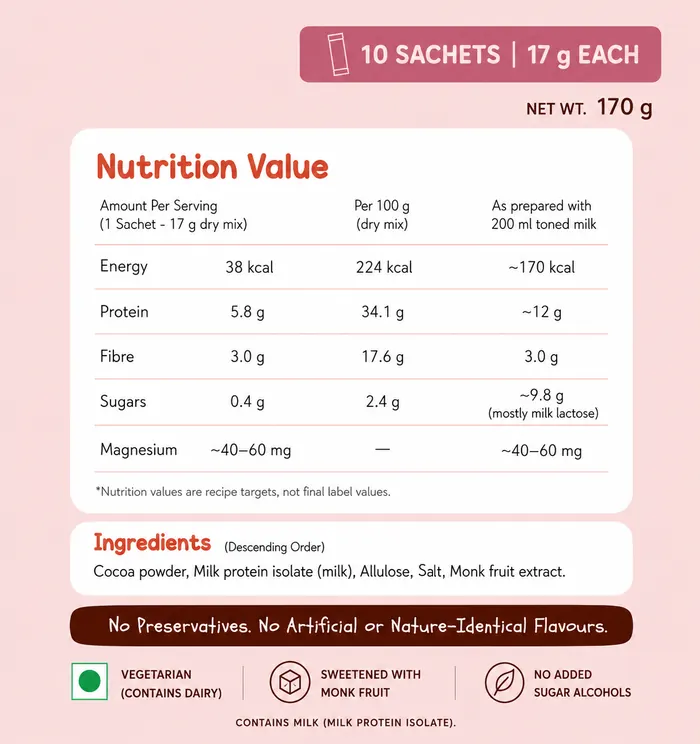
So we didn't use either. Cocoon's sweetness is a small amount of real sugar, a little allulose (which your body absorbs but barely uses, so it has almost no effect on blood sugar), and a pinch of monk fruit. The fibre comes from whole foods (dates, cocoa, nuts) not a powder. The sugar figure on our pack reads a touch higher than a "zero" bar's. Nothing on it will bloat you.
What to look for
Read the ingredients, not the claim on the front. If the sweetness is a word ending in -ol, or you see inulin, chicory or "soluble corn fibre" high on the list, that's usually where the bloating comes from.